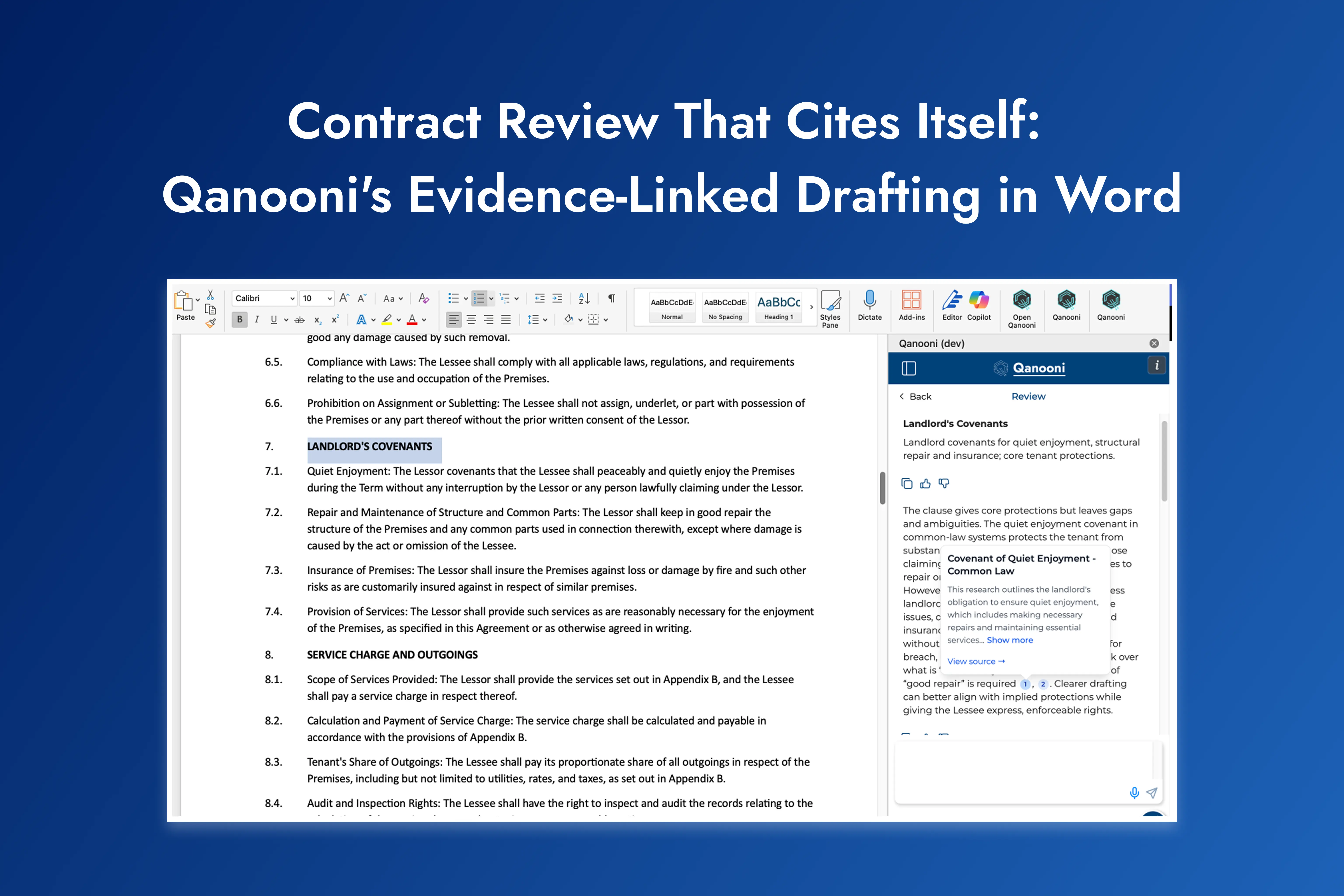
The most useful question in a redline is also the shortest: what is this based on? Good drafting is more than clean language; it is language you can defend in front of a partner, a client or the other side. Evidence‑linked drafting is contract review in Word where suggested changes carry citations to the underlying legal authority. The reviewer sees the why as well as the what, and the approval step becomes a legal judgement rather than a guess.
Evidence‑linked drafting means AI‑assisted review in Word where suggested edits arrive with citations to real legal authority. You click through, verify the source and accept in track changes. No new repository to manage; you continue to work where you already work.
Contract review in Word with clause‑level citations to legal authority.
Why the citation belongs inside the draft
Lawyers do not argue from vibes. They argue from authority. Yet most drafting tools optimise for speed over reasoning, leaving reviewers to ask for background over email, recreate the analysis or pull a colleague into the room. The outcome is familiar: faster first drafts, slower sign‑off and duplicated verification.
Citations inside the draft reverse that sequence. When a suggested change lands with a visible source, the reviewer can read, decide and move on in a single pass. That is what evidence‑linked drafting is designed to deliver. It does not invent a new process; it removes the gap between suggestion and justification.
How Qanooni grounds suggestions in real law (global, not parochial)
The core idea is simple: a drafting engine that follows the structure of the law. Qanooni organises public legal authority as a governed legal data graph, so retrieval respects jurisdiction, hierarchy and amendment lineage rather than treating text as interchangeable. The system looks for the position that governs the clause rather than a sentence that happens to sound right.
Because the coverage is global-spanning common‑law and civil‑law systems, the same habit holds across jurisdictions. A force‑majeure revision in a Southeast Asian supply contract, a consumer‑protection carve‑out in an EU services agreement, a governing‑law clarification for a cross‑border share purchase: in each case, the suggestion is anchored to an authority that can be opened and checked. For more on the model, see the legal data graph and our posture of accuracy, auditability and alignment in Trust in Legal AI.
If you want broader context on coverage, how we count thousands of legal authority databases and why the count is about usability not marketing, see Connectors: What "Coverage" Means.
How it works in Word
You open the agreement in Word and ask Qanooni to review a clause or to propose revised language. The suggestion arrives inside your document with a link to the source. You click to read the authority, decide whether it stands, and accept or modify in track changes. Nothing about your workflow changes; what changes is that every edit cites itself.
Clause‑level drafting in Word (legal AI, with citations)
Suggestions are proposed at clause level inside Word and arrive with citations to legal authority, so reviewers can verify footing and accept in track changes without leaving the document.
Clause‑level review in Word that shows its working. Qanooni proposes revised language and cites the legal authority behind it, so reviewers can open the source, verify the footing and accept in track changes without adding another system to manage.
Feature availability can vary by document context and client licensing; the workflow remains in Word, without introducing a separate external sharing workspace.
The custody story stays simple. Qanooni brings assistance to Word without introducing a separate third‑party document repository; see Keeping Lawyer IP Central in Microsoft 365 for the fuller position.
What "evidence" means in contract drafting
Evidence here is not marketing copy. It is the footing that a reviewer relies on to approve the language. In practice that means four things are visible when you click: the type of authority (statute or regulation; reported judgment or law report; regulator guidance or formal circular), the jurisdiction and forum, a pinpoint where appropriate and the currency of the position. This is not decoration. It is what makes a suggestion defensible.
The same approach works across systems that reason differently. In civil‑law settings, citations gravitate toward codified provisions and implementing regulations; in common‑law settings, they lean into reported decisions and recognised commentary. Either way, the engine is constrained by the structure of real law and the suggestion shows its working.
A day in the file: from prompt to approval
You open the document in Word. The counterparty has weakened an indemnity; governing‑law is generic; a data‑processing clause feels out of step. You ask Qanooni to review the clause. The suggestion arrives in your document, in track changes, with a citation. You click the link, read the authority and accept with confidence or adjust the language and send it back. No context hunt, no parallel memo, no blind trust. The reasoning travels with the text.
Because the citation is inside the draft, hand‑offs are cleaner. A senior associate can approve with context. A partner can justify the edit to a client in two sentences. If the other side asks "why?", the answer is already in the paper.
Speed without losing supervision
Evidence‑linked drafting does not remove human review. It reduces the verification burden and shortens the time between "this looks right" and "I can stand behind this." With citations in the draft, supervision becomes specific: the reviewer checks the authority, not the marketing page; the partner edits the reasoning, not just the words. Over time, the effect is cumulative: fewer back‑and‑forth threads asking for the basis of an edit; fewer late‑stage rewrites to restore a position that drifted.
None of this adds a new place for documents to live. You continue to draft and circulate in Microsoft Word within Microsoft 365; no separate third‑party repository is introduced.
Key facts
- Evidence‑linked drafting = suggested edits in Word with citations to legal authority.
- Grounded in public legal authority and a governed legal data graph (no vendor list).
- No separate third‑party repository; lawyers draft and approve in Word.
- Global coverage across common‑law and civil‑law systems.
What this changes for clients
Clients do not see the prompts; they see the choices. Evidence‑linked drafting gives them confidence that choices were made on footing rather than feel. It also helps explain outcomes when negotiations move quickly: the authority sits behind the text, so the rationale is not trapped in a side channel. Where internal counsel carries the paper forward, the chain of reasoning survives the hand‑off.
Frequently Asked Questions
Is there contract review AI in Word that cites sources?
Yes. Qanooni performs evidence‑linked drafting: clause‑level suggestions in Word with citations to legal authority, so reviewers can verify footing and accept in track changes.
What is evidence‑linked drafting?
Contract review in Word where each suggested edit carries a citation to legal authority, so the reviewer can open the source, verify the footing and accept with confidence.
Can I open the sources from Word?
Yes. Suggestions arrive with citations you can follow from the document itself, then accept, modify or reject in track changes.
Is this global or limited to one jurisdiction?
Global. The drafting engine follows the structure of law across common‑law and civil‑law systems and grounds suggestions in public legal authority for the relevant jurisdiction.
Does this add another document system?
No. You keep working in Microsoft Word in Microsoft 365; Qanooni does not introduce a separate third‑party document repository.
Related reading
- The Legal Data Graph, retrieval that follows the structure of the law
- Trust in Legal AI, accuracy, auditability and alignment
- Keeping Lawyer IP Central in Microsoft 365, assistance in Word, custody kept simple