Most good redlines hinge on a simple question: what is this based on?
At Inspired Thinking Group (ITG), a UK‑based marketing and content technology company, the in‑house commercial legal team moved faster because the answer was visible inside Word. With Qanooni's evidence‑linked drafting, suggested changes arrived with citations to legal authority. Reviewers opened the source, verified the footing and accepted in track changes.
Evidence‑linked drafting is contract review in Word where suggested edits carry citations to legal authority. Reviewers click to verify the source and accept in track changes. The workflow stays in Word; we don't introduce a separate third‑party document repository.
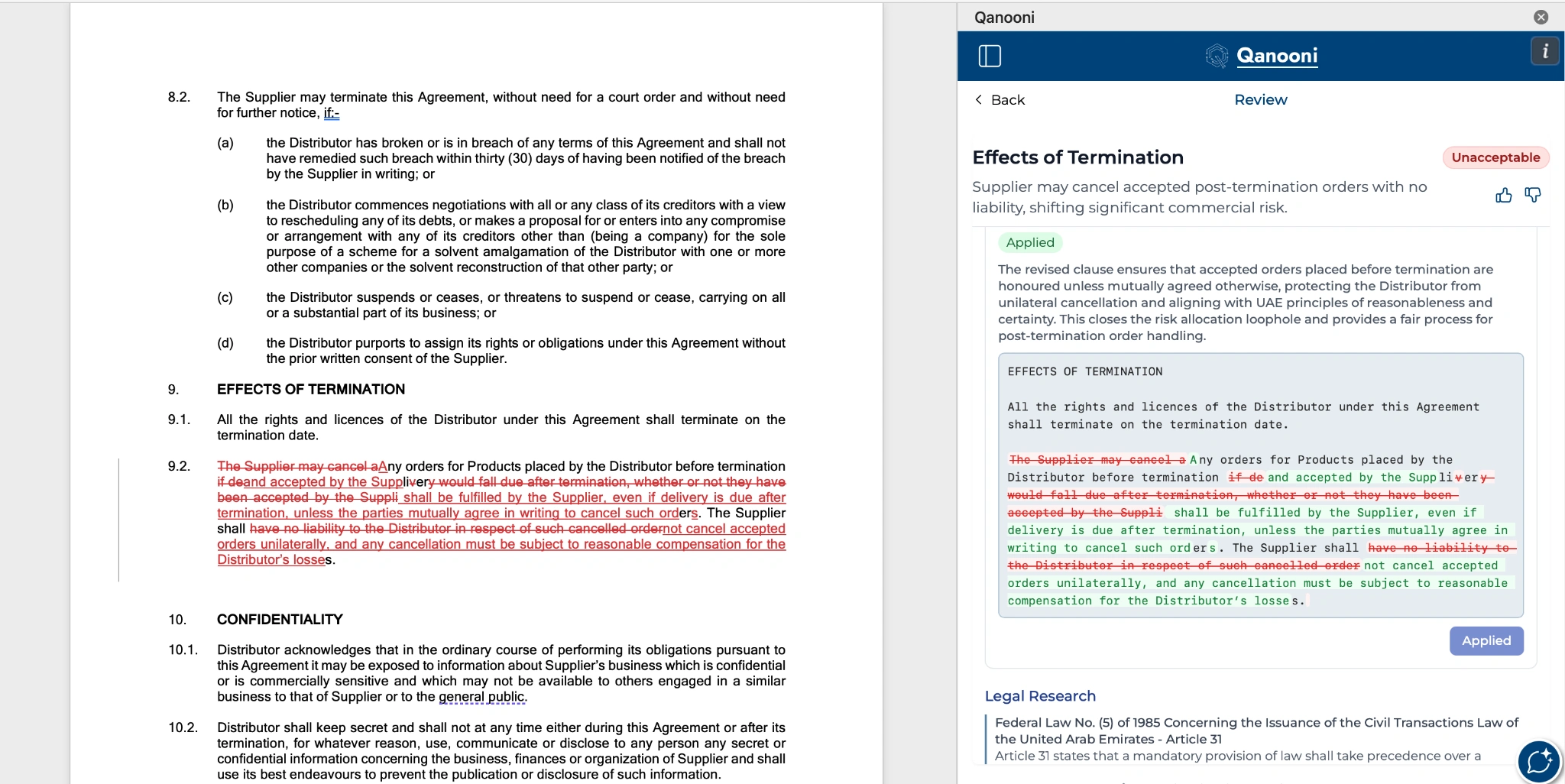
Clause‑level suggestions in Word with citations to legal authority.
Case at a glance
- Review time saving: 60% on pilot tasks.
- Personal productivity: +21% during pilot.
- Projected with M365 file integration: 25–30% personal lift expected (removing residual SharePoint/OneDrive file‑handling friction).
- Sentiment: "Genuinely transformative for my workflow.", Craig Allardice Solicitor - Contract Manager.
(Figures reflect work completed during the pilot using standard time‑keeping; outcomes vary by matter and task.)
The starting point
As a fast‑moving in‑house team supporting a global marketing/content organisation, ITG's lawyers were spending time re‑establishing footing, pulling sources, reconstructing rationale and converting "looks right" into "we can stand behind this." The brief was not to add another system. It was to keep drafting in Word, reduce verification burden and make approvals defensible.
For background on how Qanooni grounds suggestions in authority, see the legal data graph and our posture of accuracy, auditability and alignment in Trust in Legal AI.
What changed day‑to‑day
The team opened the paper in Word, asked Qanooni to review clauses and received suggestions with citations. The link did the heavy lifting: reviewers clicked to the authority, checked the position and accepted or modified in track changes. The reasoning travelled with the text, so approvals moved faster and the redline explained itself.
"The accuracy, clarity and structure of AI‑supported reviews let us turn work around in a fraction of the time, without compromising standards.", Craig Allardice Solicitor - Contract Manager ITG
Measured impact
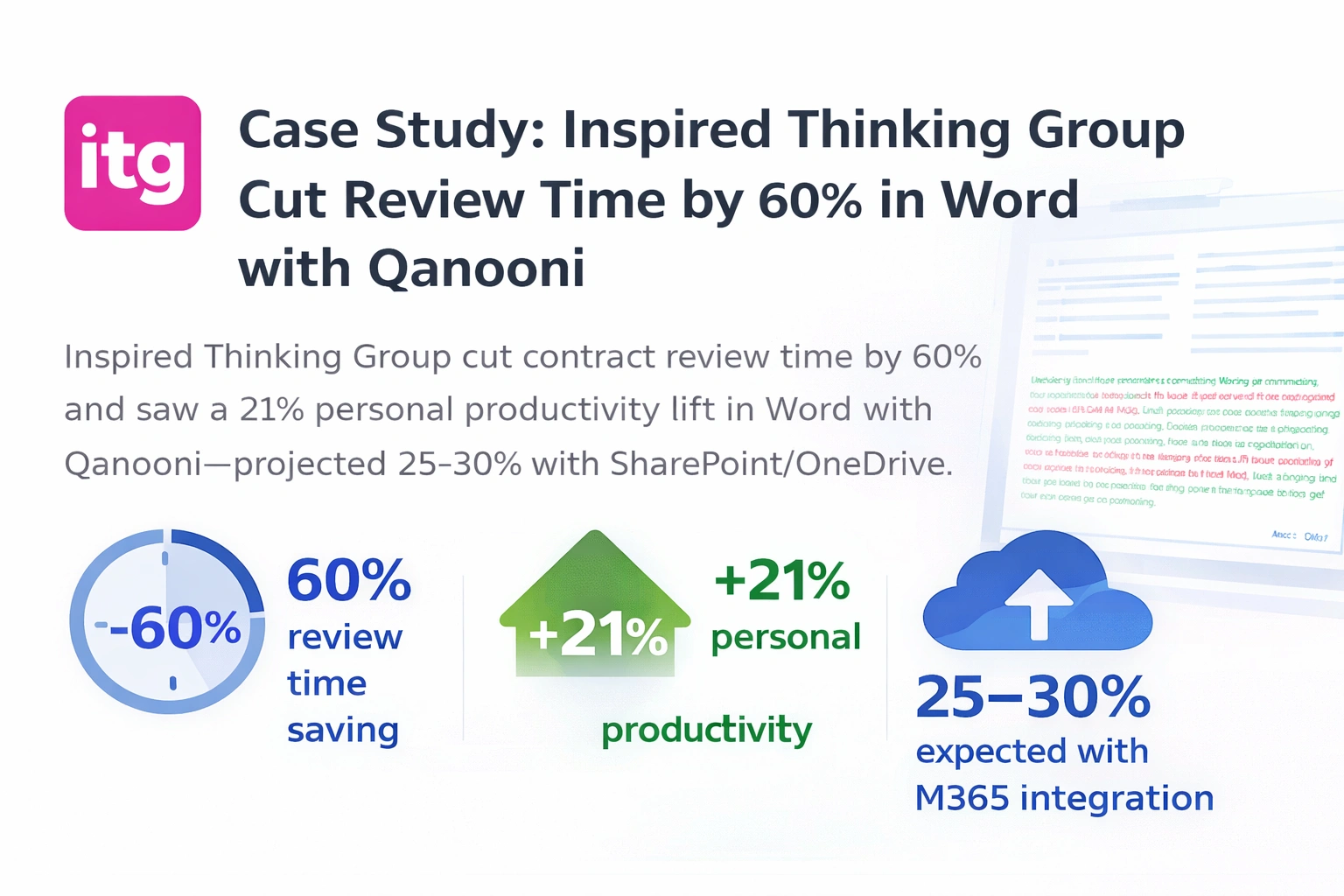
60% time saving on review tasks
The team measured like‑for‑like review tasks during the pilot and saw a 60% reduction in time spent versus baseline. The lift came from fewer email loops asking why, fewer side memos and faster acceptance when the source sat in the draft.
+21% personal productivity
Across the pilot, a 21% increase in individual productivity was reported, reflecting higher throughput and less re-work.
25–30% expected with M365 file integration
A further lift to 25–30% is expected once SharePoint/OneDrive integration removes manual file‑handling friction that still exists today.
Results were measured using ITG's standard time‑keeping. Like‑for‑like review tasks completed during the pilot were timed against prior baselines. The +21% personal figure reflects tracked throughput and hours. The 25–30% projection assumes removal of manual SharePoint/OneDrive file‑handling steps.
(Scope: measured during the pilot; task mix and complexity vary by matter. Figures reflect the team's own time‑keeping and review logs.)
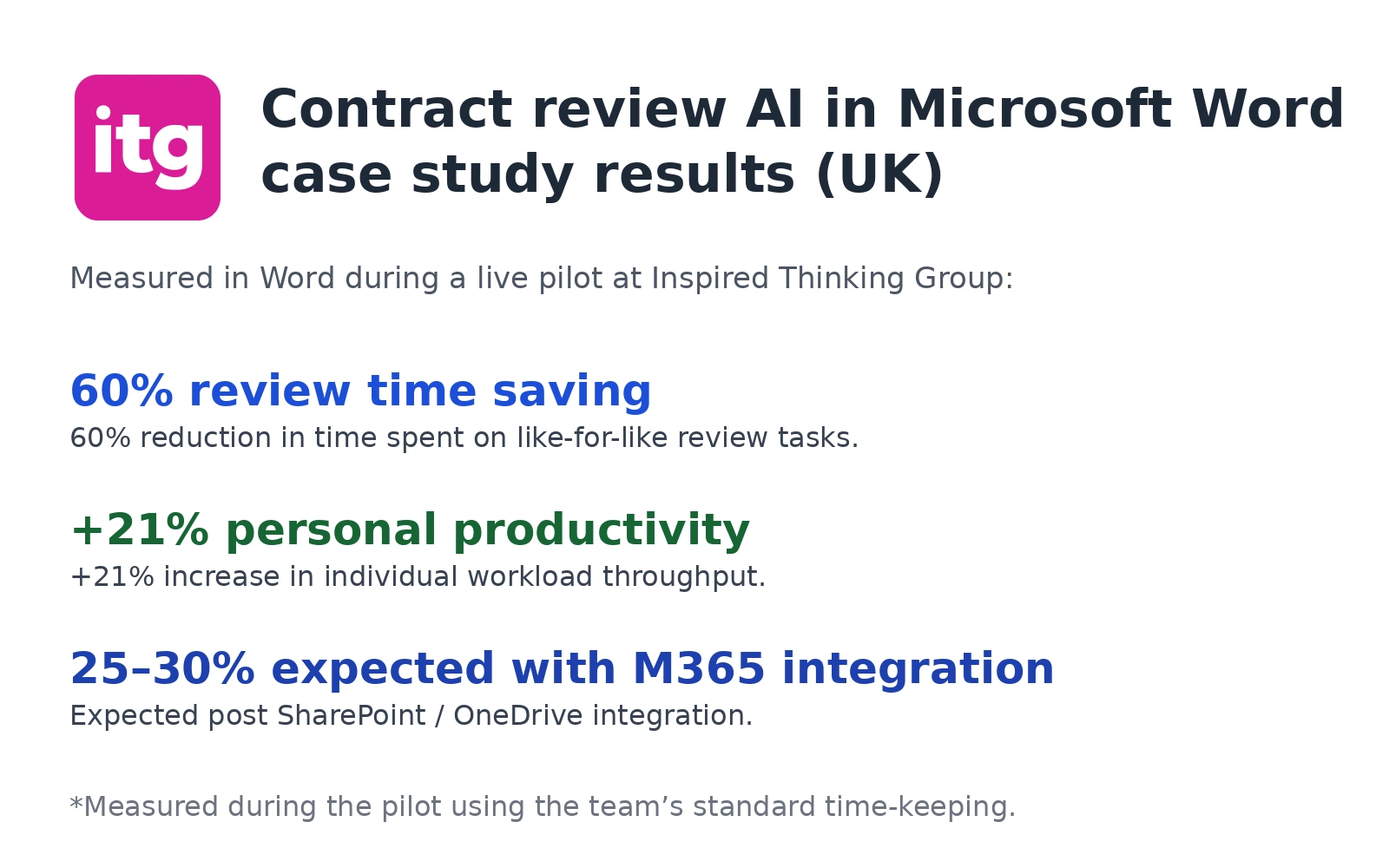
Contract review AI in Microsoft Word, case study results (UK)
Measured in Word during a live pilot at Inspired Thinking Group: 60% review time saving; +21% personal productivity; 25–30% expected post SharePoint/OneDrive integration.
Where the gains came from
- Citations in context. The citation sat next to the suggestion, so verification was a click, not a scavenger hunt.
- Cleaner redlines. Reasons were visible; negotiations focused on positions, not archaeology.
- No extra system. Work stayed in Word within Microsoft 365, which meant no added tool friction or duplicate repositories. See Keeping Lawyer IP Central in Microsoft 365 for the custody stance.
How the team used Qanooni in Word
Open the contract, select the clause, ask Qanooni to review or propose revised language. The suggestion arrives in track changes with a citation to the governing authority. Reviewer clicks, verifies and accepts.
Clause‑level suggestions appear in Word with a link to the governing authority; reviewers verify the footing and accept in track changes.
For a deeper look at the workflow, see Evidence‑Linked Drafting in Word.
Limitations & responsible use
The system reduces verification burden; it does not replace legal judgement. Citations support the decision; they do not make it. Fact‑sensitive issues still require professional analysis. Feature availability can vary by document context and client licensing; the workflow remains in Word. Qanooni brings assistance into Word, ITG kept drafting and circulating in Microsoft 365 without adding a separate third‑party repository.
Key facts
- 60% time saving on review tasks (pilot).
- +21% personal productivity, with 25–30% expected post M365 file integration.
- Evidence‑linked drafting in Word, citations to legal authority included.
- No separate third‑party repository introduced; custody remains within Microsoft 365.
In Word during a live pilot at Inspired Thinking Group, the team saw 60% review time saving and +21% personal productivity, with 25–30% expected once SharePoint/OneDrive integration goes live.
Frequently Asked Questions
Is there a UK case study of contract review AI in Word?
Yes. At Inspired Thinking Group, a live pilot showed 60% review time saving and +21% personal productivity, with 25–30% expected post SharePoint/OneDrive integration.
What exactly did the \"60%\" cover?
Review tasks completed during the pilot, measured against the team's prior baseline using standard time‑keeping. Mix and complexity of tasks vary by matter.
How was \"productivity\" measured?
The team lead, Craig Allardice (Solicitor, Contract Manager), tracked throughput and time spent across the pilot period and compared it to normal workload, reporting a 21% uplift.
What will SharePoint/OneDrive integration change?
It removes manual file‑handling steps that still create friction. The team expects 25–30% personal productivity once live, because fewer minutes are lost moving files between workstreams.
Did AI replace human review?
No. The goal was to reduce the verification burden, not to skip it. Reviewers still used judgement; citations made that review faster and clearer.
Related reading
- Evidence‑Linked Drafting in Word, contract review that cites itself.
- The Legal Data Graph, retrieval that follows the structure of the law.
- Keeping Lawyer IP Central in Microsoft 365, assistance in Word, custody kept simple.
- Trust in Legal AI, accuracy, auditability and alignment.
Author: Qanooni Editorial Team