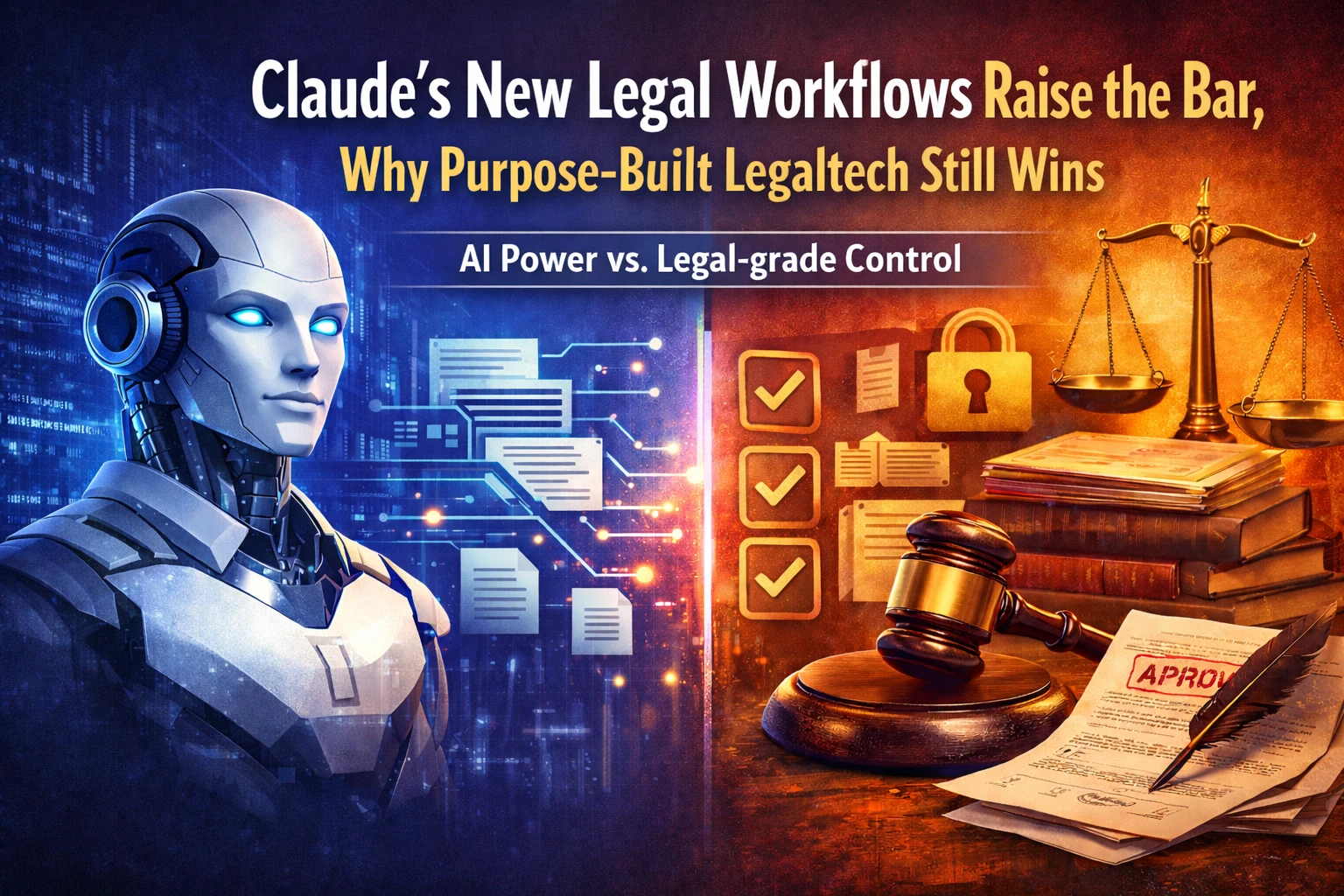
Definition: Claude "legal workflows" are packaged, AI-assisted processes for common legal tasks. They raise the baseline for what general AI can do, but they do not remove the need for purpose-built legaltech because legal teams still need governance, auditability, and workflow-native drafting that holds up under supervision.
Anthropic's announcement matters. Not because it "kills legaltech," but because it validates something every serious legal team already knows: modern models are powerful, and the market will keep getting better at packaging that power into workflows.
The next question is the one that actually matters in practice: what turns powerful AI into legal-grade work product?
If you only remember one thing: models generate language, legaltech vendors generate trust. The winners are the systems that make work verifiable, auditable, and consistent inside the tools lawyers already use.
What exactly did Anthropic launch, and why did it cause such a reaction?
Anthropic positioned a Claude-based tool for legal departments that can automate common tasks, and the market reacted because it looked like workflow automation is moving up into the model layer.
In The Guardian's coverage of the announcement, Anthropic said the tool could automate legal work such as contract reviewing, non-disclosure agreement triage, compliance workflows, legal briefings, and templated responses.
They also included the most important sentence in the entire launch, especially for law firms: "AI-generated analysis should be reviewed by licensed attorneys before being relied upon for legal decisions."
That is not a disclaimer, it is the operating model. It tells you the product category the model layer is entering: supervised, professional work.
The real takeaway: legal AI was never bottlenecked on model quality
The hardest part of legal AI is not producing fluent text. It is turning messy legal material into structured, governed context, then producing outputs that a lawyer can supervise and sign off.
This is the core point behind our stance at Qanooni:
"The constraint in legal AI has never been model capability. It's document intelligence and workflow orchestration." Ziyaad Ahmed, Qanooni co-founder
Claude can be excellent at language. That still does not solve the two things legal teams get judged on:
- Can you show your work?
- Can you prove control?
That is the gap purpose-built legaltech vendors fill.
Why legal work breaks generic workflows, even when the model is great
Legal materials are messy and context-dependent, and legal conclusions must be reconstructable. Generic workflows struggle when inputs are hostile and the review standard is high.
Most legal material is fundamentally hostile to "upload and ask" AI:
- scanned PDFs, inconsistent OCR, handwritten annotations
- legacy documents, weird formatting, schedules that override the main text
- fragmented records spanning years, with multiple versions of the "same" agreement
- cross-document context that changes meaning, defined terms, exhibits, side letters
A strong model does not fix that. It can only work with the context it is given.
What fixes it is a legal-grade pipeline: ingestion, structuring, version control, provenance, and the ability to reliably reassemble the right context at the right moment.
That pipeline is the product.
Why "auditability" is now the adoption gate, not "capability"
Legal teams adopt AI when they can control it and reconstruct decisions. Without audit-ready trails, the perceived risk outweighs the productivity gains.
Anthropic's own documentation makes this real. In its Cowork guidance for Team and Enterprise, Anthropic says Cowork activity is not captured in Audit Logs, the Compliance API, or Data Exports, and that security teams have no visibility into Cowork usage through standard enterprise monitoring tools.
This is not a critique. It is a reminder of how legal adoption works. In regulated or high-stakes environments, "it works" is not enough. You need to answer:
- What was the source?
- Who reviewed it?
- What changed from first pass to final?
- Who approved the final position?
- Can we prove all of this later?
Purpose-built legaltech vendors exist to make those answers routine, not heroic.
What purpose-built legaltech vendors provide that "legal workflows" cannot, by default
Legaltech vendors operationalize trust. They turn AI output into supervised, standardised, audit-ready work product that fits legal reality.
Here are the five capabilities that keep legal teams safe while scaling AI. Notice that none of them are "write better prose."
| What legal teams need | What it looks like in real contract work | How Qanooni is designed |
|---|---|---|
| Workflow-native drafting | Work happens where lawyers negotiate | Drafting and redlining inside Microsoft Word |
| Evidence and provenance | Every material suggestion is verifiable | Evidence-linked drafting so reviewers can validate quickly |
| Standards enforcement | Positions stay consistent across matters | Playbooks, fallback ladders, and precedent control |
| Audit-ready trails | Decisions can be reconstructed | Reviewable change history and sign-off support |
| Governance and security fit | Procurement and IT can approve it | Built for enterprise controls, not ad hoc "upload and ask" |
This is why "legal workflows" do not eliminate legaltech vendors. They increase the demand for vendors who can operationalize these five requirements.
The pitch, in plain English: why Qanooni exists in the Claude era
Qanooni exists because the value in legal AI is not the model, it is the system that makes legal work verifiable and defensible inside the lawyer's real workflow.
Claude getting legal workflows is good news. It means the market agrees that legal work is workflow work.
Qanooni's view is that the winning system does three things at once:
-
Meets lawyers where they work Contracts get negotiated in Microsoft Word. That is where drafting, redlining, comments, and sign-off happen.
-
Makes suggestions verifiable, not just plausible Legal teams do not need more text. They need less uncertainty. Evidence-linked drafting is how you reduce rewrite cycles without increasing risk.
-
Supports governance, security, and procurement reality Legal AI adoption lives or dies on audit trails, data boundaries, and the ability to show how a decision was reached.
This is what "purpose-built" means in legal. Not a nicer prompt, a safer system.
A quick example: the difference between "helpful" and "sign-off ready"
Take a liability clause in a UK SaaS agreement.
A general workflow can do something helpful quickly: summarise, suggest edits, draft a rationale.
A legal-grade system must do something harder:
- keep the clause aligned to the firm's standard position
- show the fallback ladder when negotiation pressure rises
- link the suggestion to the underlying evidence and precedent pattern
- preserve a reviewable trail of what changed and why
That is the difference between AI that impresses in a demo, and AI that survives partner sign-off at scale.
How to talk about this internally, without the hype
Frame Claude legal workflows as the baseline, then set a higher bar for production legal work: verification, governance, and auditability.
Here is a simple sentence that keeps teams aligned:
"Models will keep improving, but our risk posture depends on whether we can verify outputs and prove control."
If you use that bar, the vendor category becomes obvious: purpose-built legaltech is the layer that turns capability into confidence.
Frequently Asked Questions
Does Claude's legal workflow remove the need for legaltech vendors? No. It proves the market is moving toward workflow automation, but legal adoption still depends on audit trails, provenance, standards, and governance.
Why do audit trails matter in legal AI? Because legal work must be reconstructable. Without a reviewable trail, you increase professional risk and procurement friction.
Is this anti-Claude? No. Claude is a powerful model. The point is that legal teams need systems that make powerful models safe to operationalize.
What should legal leaders do next? Treat model-layer workflows as a baseline, then standardise a legal-grade layer for contracts: Word-native workflows, evidence-linked verification, playbooks, and audit-ready trails.