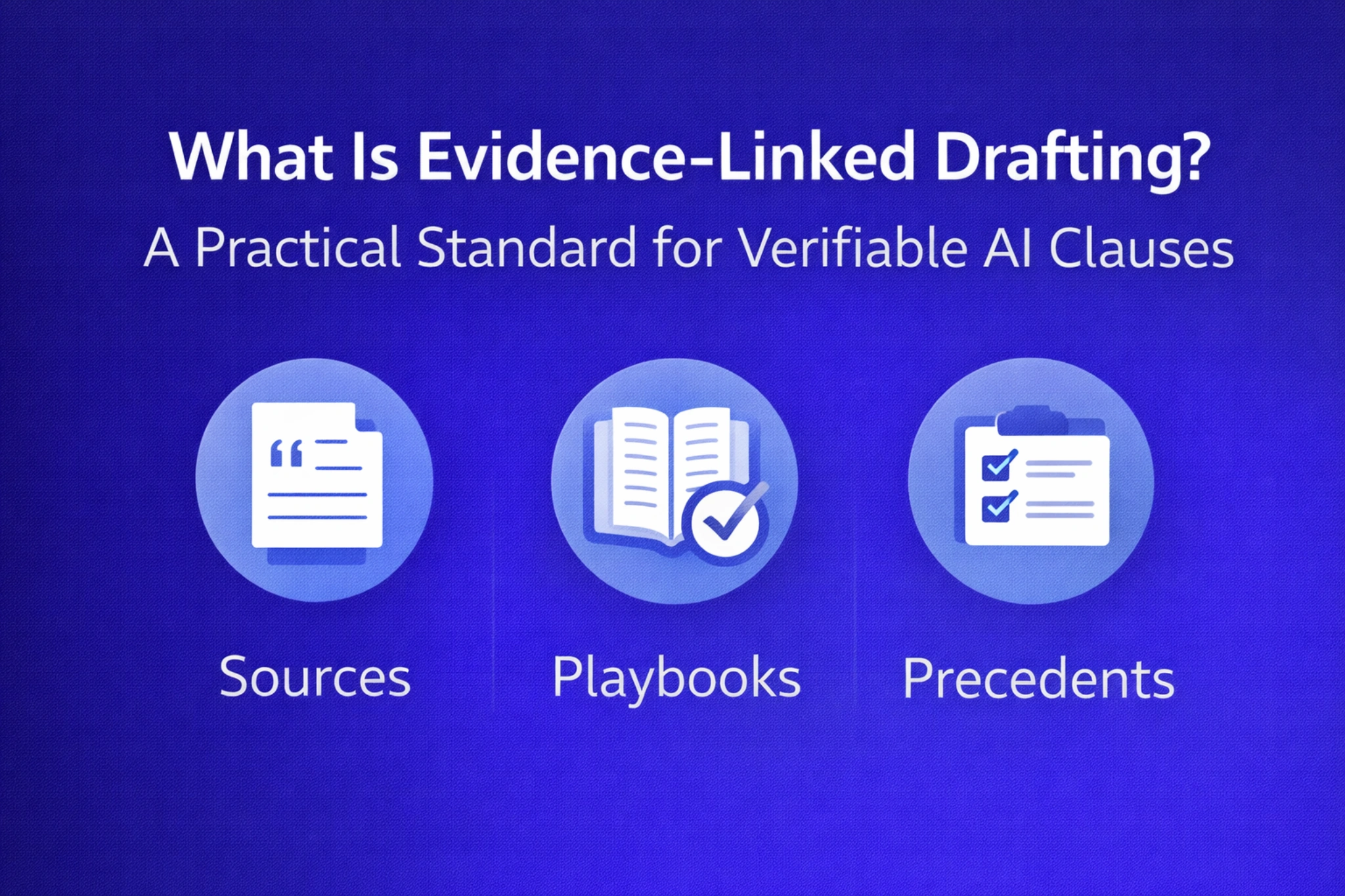
Definition: Evidence-linked drafting is a drafting standard where every material AI clause suggestion is tied to inspectable evidence, such as sources, playbooks, and precedents, so a lawyer can verify and defend the work product.
In legal work, the risk is rarely "bad writing." The risk is a clause that looks plausible but has no clear basis, which forces reviewers into detective work and makes supervision harder under time pressure.
This is why 2026's "trust" conversation is moving from abstract ethics to operational proof. As The National Law Review's 2026 predictions put it: verification, validation, and traceability are becoming the differentiators, not interface polish.
If you only remember one thing: treat AI drafting like junior drafting. The clause only becomes usable when the evidence is right there and the review path is obvious.
Source-backed claims for 2026
Plain-English answer: The legal market is explicitly shifting toward verifiable outputs and governed workflows, and multiple leaders are saying so.
Use these claims as your internal standard for what "good" needs to look like this year:
- Verification will move earlier in the workflow: The National Law Review's editor predicts courts may compel verification at the point of filing via a "Hyperlink Rule."
- Validation becomes the advantage: Scott Milner (Morgan Lewis) warns that "plausibly incorrect" outputs are harder to catch than obvious hallucinations.
- Procurement hardens around evidence: Ryan McDonough (KPMG Law) expects buyers to demand task-level evidence and traceable outputs, not generic capability claims.
- Workflow-native wins: Ziyaad Ahmed (Qanooni AI) predicts legal AI shifts from standalone chat to copilots in Word and Outlook, where verification becomes the product.
What is evidence-linked drafting?
Plain-English answer: Evidence-linked drafting is clause drafting where you can click from a suggested change to the proof that justifies it.
A tool can draft without being evidence-linked. Evidence-linked drafting means the "why" travels with the clause, not with someone's memory.
In practice, evidence-linked drafting makes review faster because it reduces the verification burden: the reviewer does not have to hunt for the precedent, reconstruct the playbook rule, or guess which source supports the sentence.
What is grounded legal drafting?
Plain-English answer: Grounded legal drafting means your draft is constrained by reliable context and evidence, not "best guess" language.
In contract work, "grounded" typically means the clause is anchored to:
- matter facts (the actual deal context),
- firm standards (playbooks, preferred positions, fallbacks),
- and when relevant, trusted external sources.
Evidence-linked drafting is a practical way to operationalise grounded drafting because it forces the system to show what it relied on.
What is drafting provenance in contract drafting?
Plain-English answer: Drafting provenance is the record of where a clause came from, why it changed, and who approved it.
Provenance is not only for litigation or audits. In day-to-day commercial drafting, provenance is what lets a senior reviewer answer simple questions quickly:
- Why did we accept this fallback?
- Which playbook rule did we apply?
- Is this consistent with our standard position?
- What changed between suggested and final text?
If you cannot reconstruct those answers quickly, you do not have a verifiable drafting workflow.
AI contract drafting with citations: what "good" looks like
Plain-English answer: "Drafting with citations" is only useful if the citation is inspectable and mapped to the clause decision, not just attached as decoration.
A citation that cannot be opened, or a citation that does not clearly support the exact sentence, does not reduce risk. It adds false confidence.
Here is a practical ladder you can use to evaluate tools:
| Level | What vendors call it | What the reviewer actually gets |
|---|---|---|
| Level 0 | "AI drafting" | Fluent text, no basis |
| Level 1 | "AI drafting with citations" | Some links, unclear mapping to clause decisions |
| Level 2 | Evidence-linked drafting | Links to playbooks, precedents, and sources for material changes |
| Level 3 | Audit-ready evidence-linked drafting | Evidence links plus logged review, approvals, and exportable trails |
If you want adoption beyond a small pilot group, Level 2 is usually the minimum where review time reliably drops.
How do you verify AI clause suggestions?
Plain-English answer: Verify the clause by opening the evidence link, checking playbook alignment, and confirming what changed between suggestion and final text.
A simple "two-minute verification test" is the fastest way to separate verifiable drafting from citation theatre:
| Check | What you do in Word | Pass signal | Fail signal |
|---|---|---|---|
| Evidence check | Open the source or precedent | The excerpt supports the claim or clause move | No link, vague link, or no excerpt |
| Playbook check | View the rule or fallback ladder | The suggestion matches a defined position or explains a tradeoff | No rule, or rule exists but is ignored |
| Context check | Confirm the clause is deal-specific | Defined terms, scope, timing are correct | Generic language, wrong scope |
| Delta check | Review what changed | You can see edits and rationale | Black box output, no tracked deltas |
If a tool cannot pass this test on a limitation of liability clause, it will not pass procurement or partner scrutiny when the stakes rise.
Related workflows
- Evidence-linked drafting in Word
- Trust and auditability in legal AI
- Measuring accuracy, recall, and risk
How do you reduce hallucinations in contract drafting?
Plain-English answer: Reduce hallucinations by forcing drafting to come from inspectable evidence and by making "no evidence, no output" a default behaviour.
In contract drafting, hallucinations often look like:
- invented "market standard" language,
- confident but unsupported claims about compliance,
- clause moves that break your standard position without explanation.
As outputs get more polished, surface-level review becomes less effective. That is why multiple 2026 predictions emphasise validation and governance: the advantage shifts to teams that can verify quickly and consistently.
Evidence-linked drafting is a practical response: it turns verification into a first-class step inside the drafting workflow.
Evidence-linked drafting in UK contract drafting: NDAs and data protection
Plain-English answer: In UK drafting workflows, evidence-linked drafting is most valuable where "looks fine" can still be commercially risky, such as NDAs and data protection schedules.
Example 1: NDA redline, confidentiality definition and carve-outs
A counterparty broadens Confidential Information and adds a disclosure carve-out that is too wide.
A generic AI can rewrite it cleanly. The reviewer's real questions remain:
- Why this carve-out wording?
- Why this notice period?
- Why this threshold?
Evidence-linked drafting answers those questions by linking:
- the playbook rule that triggered the narrowing,
- the precedent clause supporting the carve-out language,
- and the fallback ladder for timing.
Now the reviewer is choosing, not investigating.
Example 2: Data protection schedule, sub-processing and audit rights
This is where "plausibly incorrect" becomes expensive. A clause can sound right while missing your house position.
Evidence-linked drafting should surface:
- the playbook fallback ladder for sub-processing (notice, approval, objection),
- the precedent schedule used in similar matters,
- and any external authority you actually rely on, linked to the relevant excerpt.
If the basis is not visible, you have not reduced risk. You have only made risk faster.
What should firms require from evidence-linked drafting tools?
Plain-English answer: A tool is "evidence-linked" only if it makes evidence inspectable, playbook alignment default, precedent selection contextual, and review traceable.
Use these requirements as a practical standard in demos and pilots:
-
Evidence is inspectable, not decorative A citation without an excerpt still leaves a trust gap.
-
Playbooks are enforced by default If playbook alignment is optional, you will pay in rework.
-
Precedent matching is contextual Doc type, governing law, counterparty type, and deal posture matter.
-
The tool can refuse Trustworthy systems can say, "I cannot support that from the available evidence."
-
Drafting provenance exists in the workflow You should be able to reconstruct what was suggested, what was accepted, and what changed, without stitching together screenshots.
Why Qanooni: evidence-linked drafting as a workflow principle
Plain-English answer: Qanooni is designed around verifiable drafting inside Word, because trust is a workflow outcome, not a marketing claim.
One of the clearest 2026 predictions is that legal AI shifts into workflow-native copilots in Word and Outlook, and that verification becomes the product: citations, playbook checks, and audit trails become standard because untraceable output will not be tolerated.
That is the design principle behind Qanooni's approach:
- draft where lawyers work (Word),
- attach inspectable evidence to material clause decisions,
- encode firm playbooks and tone so standards are repeatable,
- support reviewable trails so supervision is fast and defensible.
If you are choosing or piloting tools in 2026, evidence-linked drafting is a clean way to separate legal-grade workflows from generic writing assistance.
Frequently Asked Questions
What is evidence-linked drafting in plain English? Evidence-linked drafting means the clause comes with its justification attached, so a reviewer can validate it quickly.
Is evidence-linked drafting the same as RAG? Not exactly. RAG can retrieve material, but evidence-linked drafting is a workflow standard: the evidence must be inspectable and tied to playbook and precedent logic.
What is the difference between citations and provenance? Citations support the content. Provenance supports the process: where the clause came from, why it changed, and who approved it.
Does evidence-linked drafting eliminate lawyer review? No. It makes review faster and more defensible because the proof is attached to the clause.
How do I pilot evidence-linked drafting? Pick one workflow (NDAs is a good start), define acceptable evidence types, run a controlled test set, then measure review time and rework reduction.
Related reading
- Contract Review Evidence-Linked Drafting in Word
- Trust in Legal AI
- Legal AI Evaluation Metrics
- Choose Legal AI Tool 2026
Author: Qanooni Editorial Team