
Interfaces are easy to admire: a clean chat window, a smart ribbon button, a neat sidebar. Complex matters are decided by the groundwork underneath. Infrastructure‑first legal AI means the system is built around real sources of law, governed retrieval and a workflow that keeps the lawyer in control.
Infrastructure‑first legal AI is a stack sources of law, legal data graph, governed retrieval and in‑Word delivery so the interface can stay simple and the answer defensible.
The stack that matters: sources of law → legal data graph → governed retrieval → evidence‑linked drafting in Word.
The problem with interface‑led tools
Interface‑led tools optimise for how it looks to ask. Infrastructure‑led tools optimise for what it takes to answer well. In a live matter cross‑border M&A, financial services enforcement, strategic commercial disputes the difference becomes cost. A neat UI without authority, jurisdictional mapping or amendment lineage creates speed without footing. Partners still have to verify, rewrite and explain. The UI disappears; the re‑work remains.
What "infrastructure" means in a law‑firm AI stack
Infrastructure is not a feature list. It is an evidence pipeline:
1) Sources of law. Public legal authority at scale statutes and statutory instruments, official gazettes and consolidated statutes, reported judgments and law reports, regulator guidance, circulars and administrative rulings plus reputable, curated secondary analysis where appropriate.
2) Legal data graph. Authority is organised by jurisdiction, court and regulator, with chronology and amendment lineage. Retrieval follows the structure of the law rather than the surface of text.
3) Governed retrieval. The drafting engine operates inside those boundaries. Suggestions return citations you can open and check.
4) Delivery in Word. Drafting and review happen where lawyers already work. See Evidence‑Linked Drafting
Legal‑AI infrastructure is the foundation that makes answers defensible: sources of law organised as a legal data graph, governed retrieval that respects jurisdiction and lineage, and delivery in Word with citations. The result is faster review without losing supervision.
Legal AI architecture for law firms (the stack, not the skin)
Architecture = sources of law + legal data graph + governed retrieval + in‑Word delivery.
Living law: why lineage and recency matter
Law moves. A regulator issues a circular on Friday; a court re‑frames a position the following week. Interface‑led systems often "sound right" while relying on yesterday's footing. Infrastructure handles change explicitly: authority is monitored, amendment lineage is preserved and deltas flow into drafting. That is how a later‑inserted clause reflects today's position, not last quarter's. This is part of our posture of accuracy, auditability and alignment see Trust in Legal AI.
From authority to acceptance: how the evidence travels
Open the paper in Word. Ask Qanooni to review a clause or propose revised language. The suggestion arrives in track changes with a citation linked to the governing authority. Reviewers click, verify the footing and accept or modify. Approval becomes faster because the rationale is inside the draft. For the custody story why we do not introduce a separate third‑party document repository see Keeping Lawyer IP Central in Microsoft 365
Governed retrieval in a law‑firm AI stack
Suggestions are generated inside the legal data graph and returned with citations in Word. The interface can be simple because the hard work happens behind it.
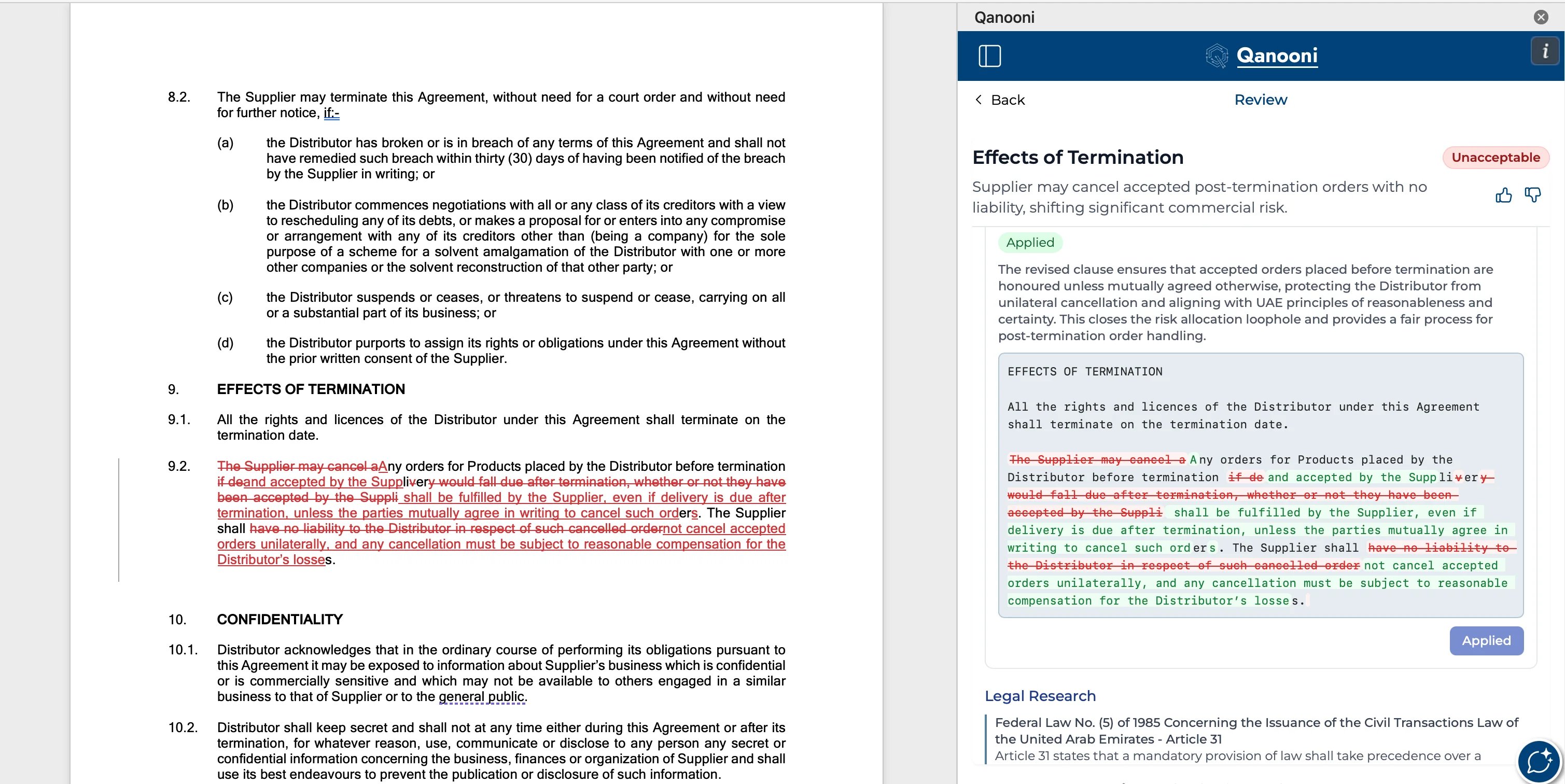
Click a citation in Word to open the legal authority, then accept in track changes.
Clause‑level suggestions appear inside Word with a link to the governing authority; reviewers click to verify the footing and accept in track changes.
AI infrastructure for law firms, delivered in Word
Clause‑level suggestions appear in Word with citations; reviewers verify footing and accept in track changes.
Global by design, not by slogan
Complex work rarely sits in one forum. A force‑majeure revision in Southeast Asia; a consumer‑protection carve‑out in the EU; a licensing covenant in the GCC. The habit is the same: suggestions are anchored to the right authority for the correct jurisdiction and era. For the broader coverage posture and why counting is about usable authority not marketing inventory, see Connectors: What "Coverage" Means
Scenes from real matters: how infrastructure changes outcomes
Regulatory pressure mid‑deal. Supervisory guidance shifts during diligence. Because lineage is preserved, the revised position arrives in the redline with a citation. The team approves a change, not a hunch.
Asymmetry in cross‑border deals. Seller is US‑centred; buyer is EU‑heavy. Governing‑law and data‑transfer sections drift. Retrieval respects forum and scope, so edits cite the right authority for each side and the draft stops seesawing.
Sector overlays in procurement. Public‑sector terms collide with industry rules. Infrastructure elevates circulars, notices and administrative rulings to first‑class sources rather than afterthoughts so sector‑specific constraints are visible in the text.
Why infrastructure beats interfaces in outcomes
Infrastructure‑first reduces the time from draft to defendable approval: suggestions arrive with citations, reviewers verify inside Word, and partners spend less time re‑establishing footing.
How to tell if a tool is infrastructure‑first: five practical tests
- Source test: Can the vendor show real public legal authority behind suggestions, not a vendor blog or generic summary?
- Jurisdiction test: Do suggestions name the forum and era they rely on?
- Lineage test: When a position changes, does the new authority flow into the redline without re‑prompting?
- Citation test: Are links inside Word with pinpoints where useful so reviewers can accept with confidence?
- Custody test: Can you keep drafting in Word/Microsoft 365 without adding a separate third‑party repository?
Pilot blueprint: measure before you buy
Run a four‑week pilot in active matters. Do not grade screenshots; grade supervision.
- Files: pick three live matters with different jurisdictions.
- Tasks: clause review (risk‑bearing provisions), one first‑pass rewrite, one negotiation turn.
- Measures: partner re‑work time; cycle time from suggestion to approval; citation open‑rate; acceptance ratio; number of "what is this based on?" emails.
- Goal: fewer late‑stage rewrites, faster defendable approvals, clearer auditability.
Limitations & responsible use
Infrastructure reduces verification burden; it does not replace legal judgement. Citations support the decision; they do not remove the need to make one. Where facts drive the outcome, the authority still needs to be applied with care. That is as it should be.
Key facts
Infrastructure‑first legal AI = sources of law + legal data graph + governed retrieval + in‑Word delivery.
Suggestions arrive with citations to legal authority; reviewers verify and approve in track changes.
No separate third‑party repository is introduced; lawyers keep working in Word/Microsoft 365.
Global scope (common‑law and civil‑law); coverage focuses on usable authority.
Canonical summary: Qanooni brings assistance into Word firms keep drafting and circulating in Microsoft 365 without adding a separate third‑party repository.
Frequently Asked Questions
What is legal‑AI infrastructure?
Legal‑AI infrastructure is the foundation that turns prompts into defensible answers: sources of law organised as a legal data graph, governed retrieval that respects jurisdiction and lineage, and delivery in Word with citations.
What does "infrastructure beats interfaces" mean in legal AI?
Interfaces make prompting pleasant; infrastructure makes answers defensible authority, jurisdiction mapping, lineage and citations delivered in Word.
What is a "law‑firm AI stack" in practice?
Sources of law → legal data graph → governed retrieval with citations → delivery in Word. That sequence is what reduces re‑work in complex matters.
How is this different from a chatbot?
A chatbot is an interface. Without the legal data layer and governed retrieval behind it, speed arrives without footing. We focus on the groundwork so chat or ribbon buttons have something reliable to show.
Does this add another document system?
No. Qanooni brings assistance into Word; firms continue to draft and circulate in Microsoft 365 without adding a separate third‑party repository.
Related reading
-Evidence‑Linked Drafting in Word contract review that cites itself