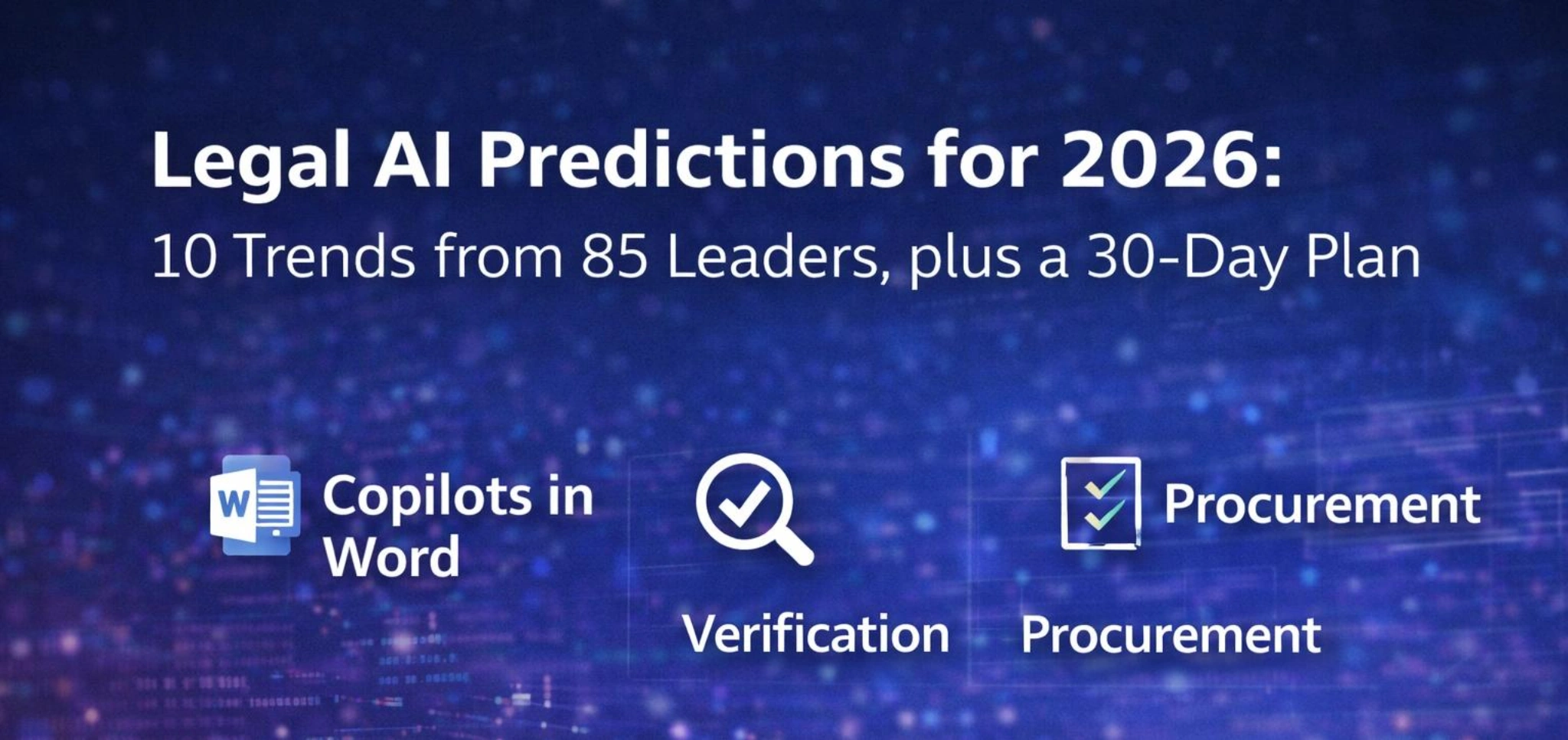
Definition: Legal AI in 2026 shifts from "ask a chatbot" to "run a governed workflow," where outputs are traceable, reviewable, and produced inside the tools lawyers already use.
According to the National Law Review's 2026 roundup of 85 predictions from legal professionals across practice, academia, and legal tech, the next wave of adoption is not about novelty. It is about operational dependency, procurement scrutiny, and defensible work product.
In legal work, the risk is rarely that AI writes something ungrammatical. The risk is that a plausible draft, email, or filing leaves your organisation without a clear source trail, without review checkpoints, and without a record of who signed off.
If you only remember one thing: 2026 will reward legal AI that makes verification easy inside the workflow, not legal AI that generates more text.
Source : 85 Predictions for AI and the Law in 2026
1-minute answers: the 2026 shift in legal AI
Answer: Legal AI in 2026 becomes workflow infrastructure, and verification becomes mandatory.
- Where AI lives: inside Word and Outlook workflows, not a separate chat tab.
- What buyers demand: citations, audit trails, and governance proof.
- Who enforces it: procurement, clients, insurers, and courts.
- What wins: fewer tools, deeper integrations, measurable workflows.
What does the 2026 survey baseline tell us before the predictions?
Answer: Leaders are not betting on AGI next year, they're betting on governance, training gaps, and enforceable verification.
According to the National Law Review roundup, respondents were asked baseline questions before sharing predictions. Those baselines matter because they frame 2026 as an "operationalization year," not a science fiction year.
| Baseline question | Reported signal | What it implies for 2026 |
|---|---|---|
| Will AGI happen in 2026? | Strong "no" consensus (77.4% said no) | Plan for workflow systems, not autonomy narratives |
| Will AI replace entry-level lawyers in 5 years? | Majority said no (58.3%) | Juniors shift toward supervision and QA, not elimination |
| Are law schools preparing students for AI-enabled practice? | 84% see significant gaps or worse | Firms must train verification and judgment internally |
| Should fabricated AI citations lead to disbarment? | No consensus | Expect more controls, uneven penalties, and stronger process expectations |
Methodology note: The article notes respondents were drawn from a professional network and are not a randomized cross-section. Treat this as a high-signal view from AI-exposed leaders, not population-level sentiment.
What are the top legal AI predictions for 2026?
Answer: The dominant theme is simple: AI becomes embedded in everyday work, and proof becomes non-optional.
Here are the 10 predictions most law firms will actually feel in 2026:
- Workflow-native copilots become the default as AI moves into drafting and negotiation surfaces.
- Word becomes the primary AI surface for drafting, redlining, and clause-level work.
- Email and matter communications become the second surface as AI supports responses and coordination.
- Verification becomes the product through citations, checks, and reviewable trails.
- Court and client pressure pushes "show your work" earlier in the lifecycle, not after problems happen.
- Smarter outputs raise the risk of plausible errors, making validation a core competency.
- Procurement hardens, turning RFPs into de facto regulation for governance and data boundaries.
- Tool overload triggers consolidation, with buyers picking fewer platforms that integrate cleanly.
- Specialisation beats generalization, with domain-specific workflows outperforming generic chat.
- Pricing pressure accelerates, forcing clearer ROI stories and tighter outside counsel guidelines.
Prediction 1: Workflow-native copilots win, Word and Outlook become the default surfaces
Answer: Adoption scales when AI lives inside the document and communication workflow, where legal work is actually produced and supervised.
According to the National Law Review roundup, one of the clearest through-lines is a shift away from standalone chat and toward embedded, workflow-native copilots.
Ziyaad Ahmed, Co-Founder of Qanooni AI, captures the direction in three short phrases:
"Legal AI will move from standalone chat to workflow-native copilots inside Word and Outlook."
Ziyaad Ahmed, Co-Founder, Qanooni AI
What "workflow-native" means in practice is not a UI preference. It is a supervision preference:
- The work stays in the document.
- Review stays attached to the work product.
- Standards can be applied consistently via playbooks.
- Adoption becomes repeatable across a team, not limited to a few prompt experts.
What to look for (quick sanity check): | Question | If the answer is "no," you likely have a chat tool | |---|---| | Can it draft and redline directly in the document workflow? | You will keep copy-pasting and losing context | | Can it use firm playbooks and preferred positions by default? | Output will drift across lawyers and matters | | Can it keep a review trail (sources, edits, approvals)? | Procurement and defensibility friction increases |
Related workflows
Prediction 2: Verification becomes mandatory, citations and audit trails become the standard
Answer: "Trust" moves from policy to product, and verification is what makes AI deployable in real matters.
According to the National Law Review roundup, fabricated citations and untraceable output have become a visible professional risk. The editor's predictions explicitly connect this to the need for front-loaded verification controls.
Ziyaad's framing is the cleanest summary for buyers:
"Verification becomes the product."
Ziyaad Ahmed, Co-Founder, Qanooni AI
In 2026, "verification" should not mean "someone will double-check later." It should mean the system is designed so a reviewer can validate quickly, without hunting, guesswork, or lore.
A practical verification stack (what serious buyers will expect): | Control | Plain English | What it looks like in day-to-day work | |---|---|---| | Citation-first drafting | "Show me where this came from" | Claims and clause suggestions link to sources | | Playbook checks | "Does this match our standard?" | Fallback positions and required language applied consistently | | Audit trail | "Who did what, when?" | Logged context, outputs, edits, and approvals | | Human sign-off points | "Who owns the risk?" | Named reviewer, recorded decision, escalation when uncertain | | Ongoing evaluation | "Is it drifting?" | Sampling and regression tests as workflows evolve |
Prediction 3: Procurement becomes the de facto regulator for legal AI
Answer: Buying processes will enforce transparency and governance, even when formal regulation remains fragmented.
According to the National Law Review roundup, enterprise buyers are moving from "can it do it" to "can it prove it," and the enforcement mechanism is procurement.
Ziyaad's "biggest surprise" is also the buying reality most firms will feel first:
"Procurement becomes the real AI regulator."
Ziyaad Ahmed, Co-Founder, Qanooni AI
In 2026, procurement questions are not nuisance questions. They are the operating standard:
Procurement checklist (copy/paste for your RFP):
- What are the data boundaries, what can the system access, and what is explicitly out of scope?
- What is stored, for how long, and under what retention and deletion controls?
- Can the system show a reviewable trail, including sources, context used, outputs, edits, approvals?
- How are roles and permissions handled by matter, team, and document class?
- How do you measure performance on our workflows, not generic benchmarks?
- What happens when the system is uncertain, missing context, or detects conflict?
If a vendor cannot answer these cleanly, procurement will eventually answer for you.
Prediction 4: Tool overload drives consolidation, specialisation, and fewer "thin wrappers"
Answer: Legal teams will choose fewer tools with deeper integration, and cut anything that cannot survive governance scrutiny.
According to the National Law Review roundup, many leaders expect the market to punish "AI tool overload." This favours platforms that integrate cleanly into existing workflows, especially document workflows, and produce measurable outcomes.
Specialisation wins alongside consolidation. The "do everything" story tends to break down at the point where legal risk sits, because contracts, filings, discovery, and compliance artifacts have different verification requirements.
Buying heuristic for 2026: pick the tool that can be governed and measured in the workflow you care about most.
Prediction 5: Agents grow, but constrained autonomy wins
Answer: Agents will expand, but the winners will constrain autonomy through structured, logged workflows with human sign-off where risk sits.
According to the National Law Review roundup, agentic systems are expected to grow, but multiple contributors emphasise governance, auditability, and predictable behaviour as the requirement for real adoption.
Treat workflows as governance infrastructure:
- Define what the system can access at each step.
- Define what it can produce at each step.
- Define where it must stop and require human approval.
- Log the chain from context to output to approval.
If you do not constrain autonomy, you do not control liability.
Prediction 6: Pricing pressure and client transparency tighten outside counsel expectations
Answer: Efficiency becomes visible, and clients respond by tightening guidelines and pushing value-based pricing.
According to the National Law Review roundup, more leaders expect pricing and outside counsel guidelines to change as AI-driven efficiencies become harder to ignore.
This is where "verification-first" becomes a commercial advantage, not just a safety story. If you can show repeatable, auditable workflows that improve quality and reduce rework, you can defend outcomes-based pricing without eating margin.
How to prepare:
- Measure time to sign-off, not time to first draft.
- Measure rework rate by clause type, not just "time saved."
- Document verification protocol so client transparency is simple and consistent.
How should law firms evaluate legal AI tools in 2026?
Answer: Evaluate legal AI on verification and workflow outcomes, not how impressive the first draft sounds.
According to the National Law Review roundup, validation and operational discipline are becoming differentiators. Use metrics that map to legal outcomes:
| Metric | What it means | Why it matters |
|---|---|---|
| Citation coverage | Percent of claims with traceable sources | Reduces verification burden and risk |
| Rework rate | How often seniors rewrite heavily | Predicts real adoption and quality |
| Time to sign-off | Time from draft to approved version | Captures speed plus trust |
| Exception rate | How often the system cannot support an answer | Reveals uncertainty handling and guardrails |
| Audit completeness | Prompts, sources, edits, approvals are logged | Procurement readiness and defensibility |
What should law firms do in the next 30 days?
Answer: Pick one workflow, build verification into it, measure outcomes, and make it procurement-ready.
A 30-day plan that matches the prediction set:
| Week | Focus | What to implement | What to measure |
|---|---|---|---|
| Week 1 | Choose a workflow | One high-frequency Word-native workflow (eg, NDA redlines, first-draft employment agreement) | Baseline cycle time and rework rate |
| Week 2 | Add verification | Source requirements, playbook checks, and sign-off points | Missing-source rate, exception rate |
| Week 3 | Standardise | Templates, roles, escalation rules, permissions | Adoption across a small group |
| Week 4 | Procurement pack | Data boundaries, retention, audit trail examples | Time-to-approval, audit completeness |
This is intentionally boring. 2026 rewards boring, defensible operations.
Why Qanooni is built for the 2026 predictions
Answer: Qanooni is designed around workflow-native drafting plus verification-first output, built to meet procurement and supervision realities.
The predictions lean toward a world where legal AI is infrastructure, not a novelty. That is why Qanooni's approach is opinionated:
- Workflow-native in Word: keep drafting and redlining where supervision already happens.
- Playbook-driven quality: make firm standards repeatable, not dependent on prompt craft.
- Verification-first workflows: make citations, checks, and audit trails part of the work product.
- Procurement readiness: make boundaries and accountability explainable without hand-waving.
If you're evaluating tools in 2026, the key question is not "can it draft." It's "can we defend this workflow to a client, a court, or an insurer."
Frequently Asked Questions
What are the top legal AI predictions for 2026?
The major themes are workflow-native copilots inside document and communication tools, verification through citations and audit trails, tougher procurement standards, consolidation, specialisation, and rising pricing pressure.
What is workflow-native legal AI?
It is legal AI embedded in the tools and steps lawyers already use, especially document drafting and review, so outputs stay in context and supervision becomes part of the workflow.
How do you reduce hallucinations in legal AI?
You design verification into the workflow: citation-first output, playbook checks, logged handoffs, and human sign-off points where legal risk sits.
What will procurement require in 2026 legal AI RFPs?
Expect proof of data boundaries, retention controls, role-based access, and reviewable audit trails for AI-assisted work product, plus task-level evidence that the tool works in real workflows.
What metrics prove legal AI is working in practice?
Citation coverage, rework rate, time to sign-off, exception rate, and audit completeness are strong indicators because they map to quality, trust, and procurement readiness.
Sources
Author: Qanooni Editorial Team
Last updated: 2026-01-08