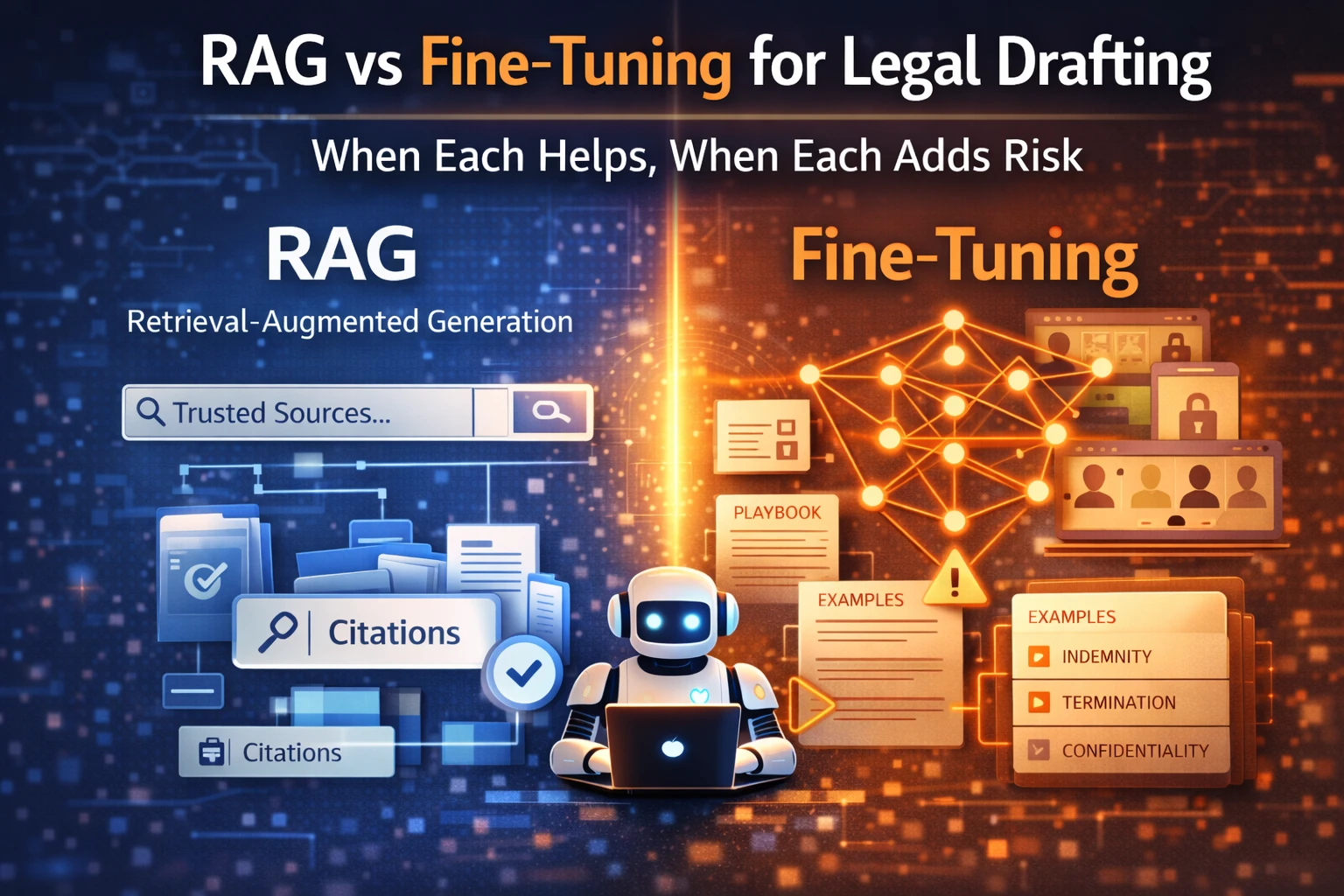
Definition: RAG (retrieval-augmented generation) improves legal drafting by fetching relevant sources at draft time, while fine-tuning changes model behaviour by training it on examples. In legal work, RAG mainly helps with grounding and verification, fine-tuning mainly helps with style and repeatable formats.
Legal teams often treat this as an engineering choice. In practice, it is a governance choice. The wrong approach can increase review burden, make outputs harder to justify, and create security and IP questions that procurement will not accept.
This matters even more in 2026 because the market is shifting from "can it draft" to "can we trust it." In The National Law Review's 2026 predictions roundup, Qanooni co-founder Ziyaad Ahmed predicts: "Verification becomes the product," and that procurement becomes the forcing function for controls and audit trails.
If you only remember one thing: use RAG to make clauses verifiable, consider fine-tuning only when you need consistent style or structured outputs, and never use fine-tuning as a substitute for evidence.
What is RAG in legal AI?
RAG is a method where the system retrieves relevant material, such as precedents, playbooks, or trusted sources, and uses it to draft with context.
In legal drafting, RAG is valuable because law is context-sensitive and time-sensitive. Even when the underlying model is strong, the draft still needs the right basis: which fallback ladder applies, what your house position is, and what the trusted source actually says.
RAG is also the simplest way to make drafting reviewable, because it can surface what was used alongside what was written.
What is fine-tuning in legal drafting?
Fine-tuning adjusts a model's behaviour by training it on examples, so it learns your preferred patterns and outputs more consistently.
Fine-tuning can be useful when you need predictable structure: consistent clause headings, consistent definitions, consistent drafting tone, or consistent classification outputs.
Fine-tuning is not the best tool for knowing the right answer in legal drafting. If the goal is accuracy, recency, and justification, you usually still need retrieval and verification.
RAG vs fine-tuning: what's the difference?
RAG changes what the model sees at draft time, fine-tuning changes how the model behaves in general.
| Dimension | RAG | Fine-tuning |
|---|---|---|
| What changes | The context supplied at runtime | The model's behaviour via training |
| Best for | Grounding, citations, internal precedents, playbooks, recency | Style, formatting, consistent patterns |
| Main risk | Bad retrieval leads to bad drafting, plus injection and context errors | Governance, privacy, drift, harder updates |
| Review benefit | High, because you can show what was retrieved | Mixed, outputs may be consistent but less explainable |
| Update model | Update sources and indexes, usually fast | Retrain, validate, deploy, slower |
A practical way to think about it: RAG is for evidence, fine-tuning is for behaviour.
When does RAG help legal drafting?
RAG helps when the drafting task depends on firm-owned knowledge or trusted sources, and when verification matters.
RAG tends to be the right default for legal drafting workflows like: - drafting and negotiating clauses against your playbook positions, - reusing precedent safely, without copying the wrong variant, - producing drafts with citations or evidence links, - drafting in regulated contexts where why matters as much as what.
RAG is also how you handle change. When guidance, policy, or your internal positions evolve, retrieval-based systems can reflect updates without retraining a model.
When does fine-tuning help legal drafting?
Fine-tuning helps when your problem is consistency of output format or tone, not what is true.
Fine-tuning can be justified when you need: - consistent clause style and tone across teams, - predictable document structure and formatting rules, - more reliable rewrite to match house style behaviour, - structured outputs for downstream automation, such as classification labels or clause type tagging.
Even then, many teams get most of the value with playbooks, templates, and strict output formats, without fine-tuning. Fine-tuning is worth it only when simpler controls cannot reliably produce the consistency you need.
When does fine-tuning add risk in legal drafting?
Fine-tuning adds risk when it creates governance complexity, confidentiality exposure, or false confidence in correctness.
In legal work, fine-tuning risk usually shows up as one of these problems:
| Risk | What it looks like in practice | Why it matters |
|---|---|---|
| Confidentiality and IP exposure | Training examples contain sensitive client data | Procurement and client guidelines may block it |
| Drift over time | The tuned behaviour becomes misaligned with current standards | Requires retraining and revalidation |
| False confidence | Consistent output feels right even when wrong | Harder to catch plausibly incorrect drafting |
| Harder explainability | You cannot easily show why a model chose language | Review burden increases |
| Higher operational burden | More testing, versioning, approvals | Slower iteration, higher cost |
If you cannot explain to a partner or a client why a clause is the way it is, the workflow will not scale.
Is RAG better than fine-tuning for legal drafting?
For most legal drafting, yes, because the job is grounding and verification, not imitation.
Legal drafting is not just a writing task. It is a controlled decision-making task. The clause needs a basis, a fallback ladder, and a review path. RAG helps supply the basis and makes it inspectable.
Fine-tuning can still help, but mostly as a second layer for consistency, after you have solved grounding.
Can you combine RAG and fine-tuning?
Yes, but only if you separate responsibilities: RAG for evidence, fine-tuning for format and style.
A sensible combined pattern looks like this:
User in Word
  -> Task framing (clause type, negotiation posture)
  -> Retrieval (playbook, precedents, trusted sources)
  -> Drafting with evidence links (RAG output)
  -> Optional style layer (light fine-tuning or controlled rewrite)
  -> Evaluation checks (accuracy, recall, risk)
  -> Logged decisions (what was suggested, what changed)
The core idea is hybrid, but disciplined. Fine-tuning should never be the only grounding mechanism.
What are the biggest RAG risks in legal drafting?
The biggest RAG risks are retrieving the wrong material, retrieving outdated material, and letting retrieved text steer the model incorrectly.
RAG can go wrong when: - your documents are duplicated and not governed, - your chunking and metadata do not reflect how lawyers search, - the system retrieves close enough text that is contextually wrong, - untrusted documents inject instructions or bias the drafting.
The fix is not better prompting. The fix is better coverage, better filtering, better provenance, and evaluation that tests the whole workflow.
How should firms evaluate RAG vs fine-tuning in a pilot?
Evaluate the workflow, not the model, using repeatable test packs and metrics that reflect review burden and risk.
A practical evaluation should include: - a small test pack of real clauses and redlines, - a defined playbook position and fallbacks, - and measurement of time-to-approval and rewrite rate.
The two-minute architecture test
Ask these four questions in a pilot. If you cannot answer them clearly, the architecture is not ready.
| Question | Why it matters | What good looks like |
|---|---|---|
| Where does the clause basis come from? | Trust and defensibility | Inspectable sources, precedents, playbook rules |
| How do updates flow in? | Recency and governance | Source updates, versioned playbooks, logged changes |
| What does the reviewer see? | Adoption | Evidence links, deltas, reviewable trail |
| How do you measure risk? | Procurement readiness | Accuracy, recall, risk metrics tied to workflow |
What procurement will ask in 2026
Procurement will ask for proof of data boundaries, governance, and reviewable trails, not just what model you use.
In The National Law Review's 2026 predictions roundup, Ziyaad Ahmed predicts that procurement becomes the real AI regulator, with RFPs requiring proof of data boundaries, governance, and reviewable audit trails.
For RAG vs fine-tuning, that translates into practical questions: - What content can the system access, and what cannot it access? - Can we show what sources were used for this clause suggestion? - How are playbooks and precedents governed and updated? - What trail exists for review and approval?
Architectures that make those answers easy will ship faster in real organisations.
Why Qanooni: grounded drafting, evidence links, and workflow-native verification
Qanooni is designed to make legal drafting verifiable inside Word by combining retrieval, firm standards, and reviewable trails.
Qanooni's approach aligns with a verification-first view of legal AI: - retrieve relevant sources and firm-owned context when drafting, - keep playbooks and precedents central to consistency, - support evidence-linked drafting so reviewers can verify quickly, - design around real workflows in Microsoft Word, not a separate drafting surface.
If you want a practical architecture outcome, not just a model choice, the question is simple: can your team draft, verify, and sign off with confidence, without leaving the document.
Frequently Asked Questions
Is RAG the same as citations? No. RAG retrieves context for drafting. Citations are a review artifact. A good workflow uses RAG to retrieve, then presents evidence links or citations so the reviewer can validate.
Does fine-tuning reduce hallucinations? Not reliably. Fine-tuning can make outputs more consistent, but hallucination risk is usually reduced by grounding, verification, and evaluation.
Which is better for firm playbooks, RAG or fine-tuning? RAG is usually better, because playbooks change and need to be inspectable. Fine-tuning may help enforce a style, but it is not a substitute for evidence.
Can we avoid fine-tuning entirely? Often yes. Many teams get consistency using structured playbooks, templates, and controlled output formats, plus retrieval.
Related reading
- Evidence-linked drafting
- How to choose a legal AI tool in 2026
- Measuring accuracy, recall, and risk
- From source to clause (Legal Data Graph)
Author: Qanooni Editorial Team