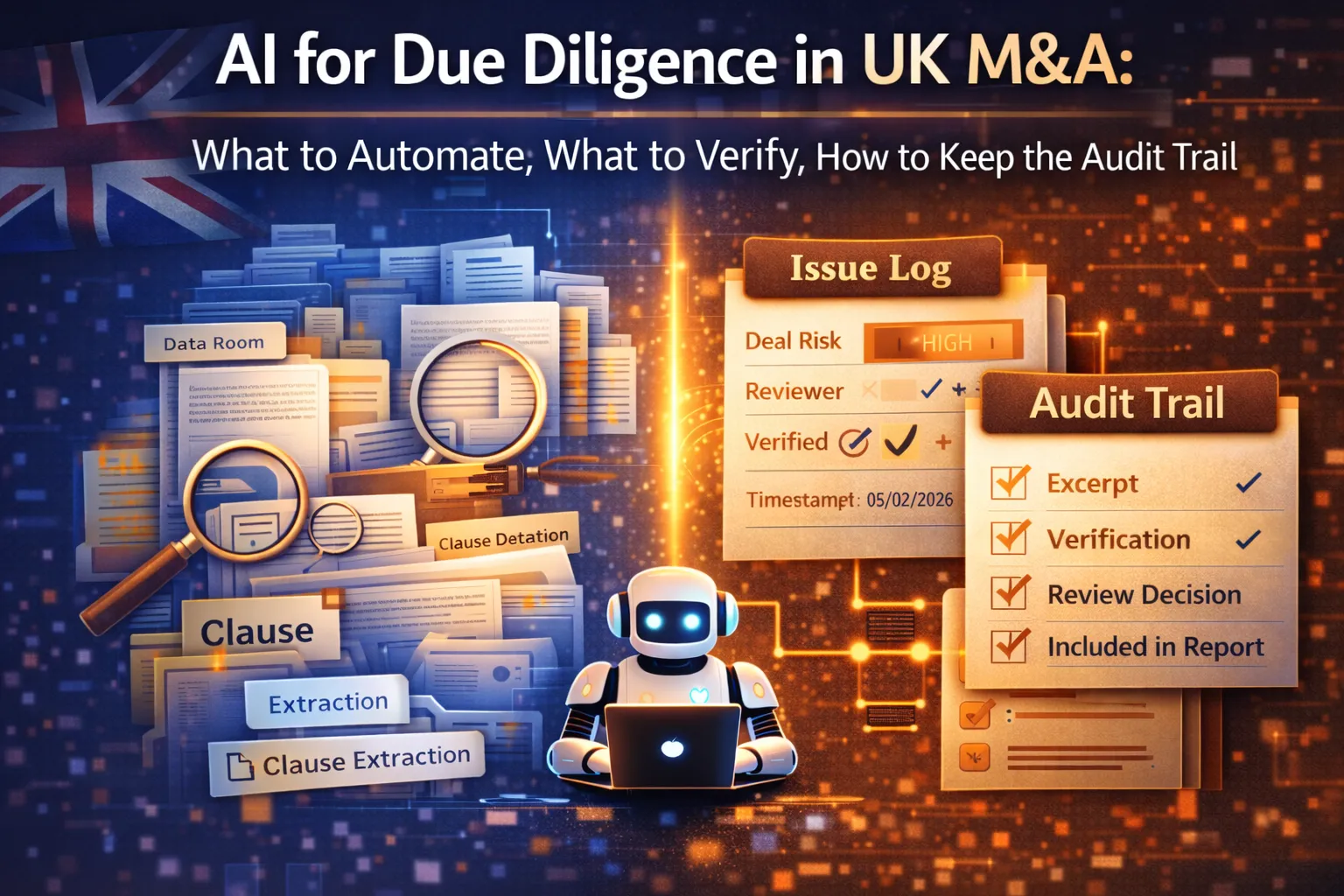
Definition: AI for due diligence in UK M&A is using AI to accelerate document review and issue spotting, while keeping every material finding verifiable and reviewable through a clear audit trail.
Due diligence is not a writing task. It is a judgment task performed under time pressure across large document sets, where "plausible" is not the same as "true."
AI can help, but only if you treat it like a junior team member: it can triage, extract, and draft, but it still needs supervision, verification, and a record of how conclusions were reached.
If you only remember one thing: automate the repetitive work, verify the high-risk work, and log the path from document to finding to sign-off.
Three rules that keep AI diligence safe:
- If it is not linked to an excerpt, it is not a diligence finding.
- If it changes deal risk, deal price, or deal mechanics, it gets verified by a human.
- If it goes in the report, it needs an owner, a decision, and a timestamp.
What is M&A due diligence?
M&A due diligence is the structured review of a target's documents to identify risks, obligations, and deal-impacting issues before completion.
In UK M&A, diligence typically aims to answer:
- What risks exist, how material are they, and who owns them?
- What needs to be disclosed, negotiated, mitigated, or priced in?
- What goes into the report, and what becomes a negotiation point?
AI can accelerate this work, but it does not replace the need for accountable review.
What is an M&A due diligence report?
An M&A due diligence report is the written output that summarises material findings, explains why they matter, and documents recommended actions or mitigations.
A report is not just a summary. It is an auditable record of professional judgment.
A simple report structure most teams recognise:
| Report section | What it typically includes | Where AI helps |
|---|---|---|
| Executive summary | Key issues and themes | Draft from validated issues log |
| Findings by workstream | Contract, employment, IP, data protection, disputes | Draft sections once findings are verified |
| Issue log summary | Material issues, severity, owner, next step | Draft the first-pass log for review |
| Appendices | Document lists, excerpts, references | Link evidence and keep version control |
A good rule: AI can help draft the report, but only after the underlying finding is linked to a source excerpt and has been reviewed.
What is AI due diligence UK?
AI due diligence UK is using AI to classify documents, extract relevant clauses, draft issue logs, and surface outliers, while keeping findings verifiable and audit-ready.
When firms say "AI due diligence," they usually mean one of these outcomes:
- faster document triage,
- faster extraction of key clauses and definitions,
- faster issue-log creation,
- faster reporting drafts.
The risk is also consistent: outputs that look confident, but cannot be reconstructed, verified, or defended later.
Source-backed signals for 2026
In a 2026 predictions roundup published by The National Law Review, Qanooni co-founder Ziyaad Ahmed argues that "verification becomes the product," and that procurement increasingly requires proof of governance and reviewable trails for AI-assisted work. The due diligence translation is straightforward:
- If a finding is not verifiable, it will not scale beyond small teams.
- If a workflow is not audit-ready, it will not survive procurement scrutiny.
- If output is not linked to evidence, review time goes up, not down.
What is legal due diligence automation?
Legal due diligence automation is using technology to speed up repeatable tasks, such as triage, extraction, comparison, and first-pass issue logging, while preserving review and accountability.
Automation is easiest when the task can be defined precisely. The more "it depends," the more you need a human reviewer.
Here is the split that works in practice:
| Task | Automate | Keep in the reviewer lane |
|---|---|---|
| Triage and routing | Classify doc types and route to workstreams | Confirm edge cases and missing documents |
| Extraction | Pull target clauses, definitions, schedules | Confirm scope, carve-outs, and interactions |
| Comparison | Spot differences across versions | Decide whether changes are acceptable |
| Issue-log drafting | Draft findings and suggested questions | Confirm severity, mitigations, escalation |
| Report drafting | Draft sections from validated findings | Approve conclusions and tone |
A simple rule: automate what is measurable, verify what is consequential.
M&A due diligence AI: what to automate first
Start with document triage, clause extraction, and first-pass issue logging, because they are high volume and measurable.
These are the highest leverage "first automations" in a UK M&A data room:
- Document triage and missing-doc detection
- Clause extraction for known risk areas
- Outlier spotting, what deviates from baseline
- Issue-log drafting with excerpt references
- Drafting questions to management for gaps and inconsistencies
If your AI diligence workflow tries to jump directly to conclusions, it becomes brittle. If it strengthens the issue log, it becomes useful.
What must you verify in AI-assisted due diligence?
Verify anything that changes deal risk, deal price, or deal mechanics, especially anything that could become a negotiation point or later dispute.
A practical way to set verification rules is by blast radius:
| Category | Examples | Verification standard |
|---|---|---|
| Deal breakers | change of control, termination triggers, exclusivity | Always verify against source text and context |
| Value impact | pricing commitments, material customer obligations | Verify against contract text and schedules |
| Compliance exposure | data protection, sanctions, bribery policies in contracts | Verify exact obligations, scope, carve-outs |
| Ownership and IP | assignments, licences, open source obligations | Verify chain, scope, exceptions |
| Employment | severance triggers, restrictive covenants | Verify triggers, thresholds, applicability |
| Disputes | claims, notices, ongoing proceedings | Verify status, materiality, timing |
In diligence, the failure mode is rarely "wrong summary." It is "right-sounding summary that missed the clause that changes the answer."
How do you keep an audit trail for AI due diligence?
Link each finding to the source document and excerpt, log who reviewed it, and record what changed from AI draft to final sign-off.
An audit trail is not bureaucracy. It is how you keep quality high while speed increases.
The minimum viable due diligence audit trail
| Audit element | What it is | Why it matters |
|---|---|---|
| Source reference | Document name, version, location | Prevents version mix-ups |
| Excerpt | Exact clause or paragraph text | Makes verification fast |
| Finding statement | One sentence issue statement | Forces clarity |
| Risk tier and owner | Severity and reviewer name | Enables escalation |
| Decision and rationale | Accept, mitigate, flag, negotiate | Captures judgment |
| Change log | What changed from first pass | Reduces black-box risk |
| Timestamp | When reviewed and approved | Supports governance |
If it is not linked to an excerpt, it is not a diligence finding. That one rule prevents most downstream chaos.
A two-minute verification test for AI diligence findings
Before a finding goes into the report, verify the excerpt, confirm the document version, confirm the issue statement, then log the decision.
Use this as a standard operating step for every material issue:
| Check | What you do | Pass signal | Fail signal |
|---|---|---|---|
| Source check | Confirm document name and version | One definitive source | Multiple versions, unclear origin |
| Excerpt check | Open the clause text | Excerpt supports the finding | Excerpt missing or vague |
| Context check | Scan surrounding text | Scope and carve-outs captured | Finding ignores carve-outs |
| Decision log | Record decision and next step | Clear outcome and owner | "We will revisit later" |
Related workflows
- Legal AI evaluation metrics (accuracy, recall, risk): Legal AI Evaluation Metrics
- Evidence-linked drafting standard: Evidence-Linked Drafting
- How to choose a legal AI tool in 2026: Choose Legal AI Tool 2026
A quick example: change of control consents in a UK share purchase
Take a set of customer contracts in a data room. You need to know whether the transaction triggers consent requirements, termination rights, or price changes.
AI can accelerate the first pass by:
- identifying change of control clauses,
- extracting the trigger language,
- drafting an issue-log entry with an excerpt reference.
The verification step is where diligence stays defensible.
A reviewer should confirm:
- whether the trigger is a share sale, asset sale, or control defined broadly,
- whether the remedy is termination, price increase, or notice only,
- whether the clause is in a master agreement or an overriding schedule,
- whether the document is current.
If the finding is material, it goes into the report only after the excerpt is checked and the decision is logged.
A quick example: data protection obligations that look standard but are not
Now take data protection, where "looks fine" can still be risky.
AI can help by:
- locating relevant clauses across multiple contracts,
- extracting breach notification timelines and audit rights,
- flagging outliers that deviate from a baseline.
Verification is the difference between signal and noise.
The reviewer must confirm:
- the scope of personal data and processing covered,
- whether obligations are contractual, policy-based, or both,
- and whether the clause applies pre-completion, post-completion, or both.
A good audit trail prevents later confusion, especially when diligence findings become negotiation points.
How do you run a safe pilot for AI due diligence in UK M&A?
Pilot on a defined doc set, define what must be verified, standardise the issues log, then measure review outcomes, not just speed.
A practical pilot plan:
-
Pick one workstream Example: material contracts, data protection, or employment.
-
Define must-verify categories Use the blast-radius table above and decide which issues require senior sign-off.
-
Standardise the issues log One sentence finding, excerpt reference, risk tier, owner, decision.
-
Run a small test pack 20–40 documents is enough to reveal failure modes.
-
Measure what matters Rewrite rate of findings, excerpt coverage on material issues, and sign-off time for the workstream.
Pilot success is not "the AI found issues." It is "the team trusted findings enough to move faster."
The due diligence worksheet
Use this worksheet to keep findings consistent and audit-ready across workstreams.
Copy and paste into your diligence tracker:
| Item | Fill in |
|---|---|
| Deal | |
| Workstream | |
| Document set location | |
| Reviewer | |
| Date |
Findings table
| Doc | Clause or section | Finding statement | Risk tier | Excerpt reference | Reviewer decision | Notes |
|---|---|---|---|---|---|---|
Why Qanooni: evidence-linked diligence and audit-ready reporting
Qanooni is designed to keep legal work verifiable and reviewable in document workflows, so diligence outputs can be supervised and defended.
In diligence, the bottleneck is not producing words. It is validating risk, escalating appropriately, and producing a report that survives scrutiny.
Qanooni's approach is designed for that moment:
- accelerate extraction and first-pass issue logging,
- keep findings evidence-linked so reviewers can verify quickly,
- preserve a reviewable trail from document to finding to decision.
If your diligence work ends in Word, the practical advantage is a workflow that keeps evidence and review close to the draft, not scattered across tabs and screenshots.
Frequently Asked Questions
What is AI due diligence UK in plain English? It is using AI to speed up triage, extraction, and issue logging in a UK M&A document set, while keeping material findings verifiable with excerpts and reviewer decisions.
Can AI replace due diligence lawyers? No. AI can accelerate repetitive tasks and surface issues, but legal judgment, verification, and risk acceptance remain lawyer responsibilities.
What is the biggest risk of AI in due diligence? Plausible but unverified findings entering the issues log or report without a clear excerpt, context, and reviewer decision.
How do you keep an audit trail in due diligence? Link findings to the exact source excerpt, record who reviewed and approved it, and track what changed from first pass to final output.
How do you measure whether AI is helping due diligence? Measure rewrite rate of findings, excerpt coverage on material issues, and sign-off time for the workstream.
Related reading
- Legal AI Evaluation Metrics
- Evidence-Linked Drafting
- Choose Legal AI Tool 2026
- RAG vs Fine-Tuning for Legal Drafting
Author: Qanooni Editorial Team